



Last Updated: 12 March 2026
Straight in Poker: Hand Rank and Best Strategy to Use
Ever wondered how to play your straights to their full potential in poker and get paid off? Getting the most out of your straight poker hands takes finesse and strategy, but can lead to massive returns. At CoinPoker, we will look over the odds and probabilities of making a straight, as well as some essential strategic tips you can use to maximize your profits.
GuidesWhat Is a Straight in Poker?
A straight is a powerful poker hand made up of five consecutive cards of various suits. For example, 5♥ 6♠ 7♠ 8♣ 9♣ makes up a Nine-high straight (from 5 to 9). Straights are always a valuable hand, but can also be vulnerable depending on the board and the situation.
The best straights are the ones made using both of your hole cards and three community cards, for example, 9♥ T♣ on a board of A♥ 3♠ 7♠ 8♣ 6♣. Overplaying the lower end of the straight or a poker straight with just one hole card can be dangerous, as such hands can be vulnerable. This is especially true for paired boards or those where a flush is possible.
Playing your straights in poker correctly comes down to understanding the odds, knowing how to read the board texture, and assessing your opponents. Using the right strategies, a straight can become one of the biggest moneymakers in your poker arsenal.
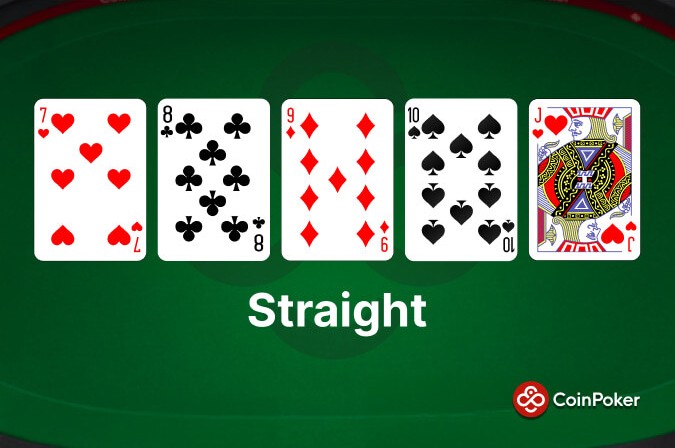
How Does a Straight Rank in Poker?
Looking at the official poker hand rankings, you will notice that a straight is ranked 5th, right in the middle.
The hand is stronger than the likes of three-of-a-kind and two pair, but weaker than flushes, full houses, and stronger hands. Yet, a poker straight is the best possible hand on many boards, and is especially powerful in games like Texas Hold’em and Seven Card Stud.
If you play Pot Limit Omaha or Five-Card Pot Limit Omaha, straights lose some of their value. The extra hole cards increase the likelihood that a player will form stronger hands. On paired boards or ones with three suited cards, straights rarely win big pots in Omaha poker. Yet, if such hands are not possible, the high end of the straight is still the best hand.
What is the best straight in poker?
A: The best straight in poker is made up of the five highest-ranked cards in the deck, such as T♥ J♣ Q♥ K♠ A♦. This straight is also known as “Broadway.”
What is the worst straight in poker?
A: The worst straight in poker is made up of the five lowest-ranked cards in the deck, such as A♣ 2♠ 3♥ 4♦ 5♣. This straight is also known as “The Wheel,” which is the best hand in lowball poker.
What Beats a Straight in Poker?
A flush, a full house, four-of-a-kind, a straight flush, and a royal flush can beat a straight. Of course, higher straights can be lower straights as well.
On average, a straight will be the best hand in most cases in Texas Hold’em. Remember that the board must have three cards of the same suit for a flush to work, and have a pair on it for a full house to be possible. In all other cases, the high end of the straight is the best possible hand.
What Does a Straight Beat in Poker?
A straight beats all high card, one pair, two pair, and three-of-a-kind combinations. Since these are the most common hands in Texas Hold’em, a straight wins more often than not. In fact, a straight is the best possible hand on many poker boards, which makes it quite powerful.
Whenever you get a straight, think about the possible hands your opponents can have. If your straight is the best possible hand, you will be looking to get paid by hands like three-of-a-kind and two pair.

Straight vs Straight – Who Wins?
A situation where two players have a straight occurs in poker. For example, on a flop of 9♦ T♠ J♣, you may have K♠ Q♠, and your opponent may have 8♦ 7♦. In this case, both you and the other player have a straight, but yours is higher. The higher end of the straight is always the winner in straight-over-straight situations.
To understand what beats what, just consider how high a straight goes. If your 5-card straight reaches the J♦ and your opponent’s only reaches a T♥, you win the pot.
What Is the Probability of Getting a Straight?
It’s time to talk about statistics and probabilities. Making a straight on the flop is somewhat rare, although not impossible. There are two types of straight draws in poker:
- Open-Ended Straight Draw: This is where cards can complete on two ends. For example, if you have J♦ T♦ on a board of 9♣ 8♠ 4♦, you can complete your open-ended straight with any Q or 7.
- Inside Straight Draw (or Gutshot): This can only be completed with one card. For example, if you have J♦ T♦ on a board of 9♠ 7♦ 4♣, you can only complete your inside straight draw with any 8.
Now, let’s take a look at the odds and probabilities of making a straight in different situations:
| Poker Situation | Your Hand (Example) | Board Stage | Board | Chance % | Chance Odds |
|---|---|---|---|---|---|
| Flopping a Straight with suited connectors | J♦ T♦ | Flop | 9♠ 8♥ 7♣ | 1.31% | 1 in 77 |
| Flopping a Straight | 6♠ 7♥ | Flop | 8♣ 9♦ 10♠ | 0.39% | 1 in 254 |
| Open-Ended Straight Draw to Straight on Turn | 6♠ 7♠ | Flop +Turn | 5♣ 4♦ A♣ → 8♣ | 17.02% | 1 in 5.9 |
| Open-Ended Straight Draw to Straight by the River | 6♠ 7♠ | Flop + River | 5♣ 4♦ K♣ → J♦ → 3♣ | 31.45% | 1 in 3.18 |
| Gutshot Straight Draw → Straight on Turn | J♣ T♣ | Flop + Turn | 8♦ 7♥ 2♠ → 9♣ | 8.51% | 1 in 11.75 |
| Gutshot Straight Draw → Straight by the River | 9♣ 5♣ | Flop + River | 8♦ 7♥ 2♠ → A♥ → 6♦ | 16.47% | 1 in 6.07 |
| Turn Open-Ended Straight Draw to Straight on the River | 8♣ 7♣ | Turn + River | 5♣ J♦ K♣ → 6♥ → 9♣ | 17.39% | 1 in 5.75 |
| Turn Gutshot to Straight on the River | J♥ 10♦ | Turn + River | A♠ 9♦ 2♠ → 7♥ → 8♦ | 8.70% | 1 in 11.5 |
As you can see, the chances of flopping a straight are quite slim, but once you make a straight draw, your hand becomes quite playable. Open-ended straight draws, in particular, have a great chance of completing and giving you a straight by the time the river card is dealt.
What is the Probability of a Straight Improving?
In a what-beats-what scenario, a straight is not the most dynamic of poker hands, as it can rarely improve to a better hand. However, a straight can improve to a higher straight, flush, or a straight flush, in some situations. Improving your straight doesn’t always mean your hand gains any extra absolute value.
Here is a look at the different ways a straight can improve and the odds of it happening:
3 Essential Straight Strategies for Your Games
A straight is a strong poker hand, but you can only extract full value from it if you play it right. Applying the right strategies with your straights will give you a chance to get the maximum value from your opponents and dominate in your games.
Here are three strategy tips on how to play your straights and get the best results every time:
Flopped straights are particularly strong hands that can get a lot of value in many situations. This is especially true on dynamic boards like 9♥ 6♥ 5♣, where your opponent can have many different made hands or draws.
On a board like this, you will want to apply an aggressive playing style. If faced with a bet, put in a raise and expect to get a lot of action. Players will have hands like sets, two pair, or flush draws, which are very hard to fold on the flop. For these reasons, putting in the big bets and raises can work like a charm when you have a straight on a dynamic board.
Bet sizing is a key poker strategy for getting the most favorable results in every situation. With your straights, you will want to adjust your bet sizing strategy depending on the board texture and your opponents’ perceived hand ranges.
We already talked about one example where big bet sizes can work well. There are other situations where you may want to bet smaller to get value, or overbet the pot to make your hand look like a bluff. For example, if you make a fairly obvious straight on the river, make a small bet to get paid by one pair. If you make a gutshot straight and it looks like your opponent may have a set, think about overbetting the pot to get max value.
Another key concept you need to think about when drawing to a straight is implied odds. Implied odds indicate the amount of money you may win if you make your hand, and these are especially important when you are drawing to a straight.
For example, imagine having T♥ 9♣ on a board of J♥ 7♦ 4♣ and facing a flop bet of $70 into a $100 pot. Your hand is not very strong and may not warrant a call according to direct odds. However, if you are up against an aggressive opponent, you may want to peel off a card. If you make your straight, you may win another $1,000 or more, as they find it hard to fold a value hand or keep on bluffing you.
Get Straight Into the Action with CoinPoker
Now that you know what a straight is and how to play it, all that’s left is to practice. At CoinPoker, you can play in affordable low-stakes poker games, as well as freeroll tournaments that require no deposit.
Join now to access a massive selection of real money games and claim the world’s best online poker bonus worth $1,500 on your first deposit.
Frequently Asked Questions About Straights
A straight is a poker hand made up of five consecutive cards of various suits, such as 5♠ 6♠ 7♠ 8♣ 9♣.
A flush, full house, four-of-a-kind, straight flush, and royal flush can beat a straight in poker.
A straight flush is a poker hand made up of five consecutive cards of the same suit, such as 4♥ 5♥ 6♥ 7♥ 8♥.
Yes, a flush beats a straight in poker, in accordance with the standard poker hand rankings.
No! A straight does not beat a full house in poker. A full house is a better hand and beats a straight in all poker games.
This means you hold four cards in sequence, needing a card at the start or end to complete your straight.
An inside straight draw needs one specific card, often in the middle, to complete the straight.
A double belly buster is a four-card hand with two different cards that can complete an inside straight.

Explore More


Guides
The go-to resource for mastering poker with expert tips and strategies. Our guides will elevate your poker skill level.
66 Posts
News
Find the latest poker news and latest CoinPoker Newsletters. Get updates about games, promotions, and crypto news.
90 Posts