



Last Updated: 12 March 2026
A Flush in Poker: Hand Rank and Best Strategy To Use
A flush in poker is five cards of the same suit. It’s a high-ranking hand that can beat your opponents, but it can also cost you all your chips if you’re not careful. Knowing how it ranks, what it beats, and the odds of getting one are all essential skills. This guide covers everything, including the best strategies for playing a flush.
GuidesWhat is a Flush in Poker?
A flush in poker is any five cards of the same suit, no matter the order. For example A♠ K♠ 8♠ 5♠ 2♠ or J♥ 7♥ 4♥ 3♥ 2♥.
While it’s one of the best poker hands, players sometimes make the mistake of overplaying weak flushes and losing big to higher flushes. The real skill lies in knowing how strong your flush is, the odds of drawing to make one, and when to get aggressive once it hits.
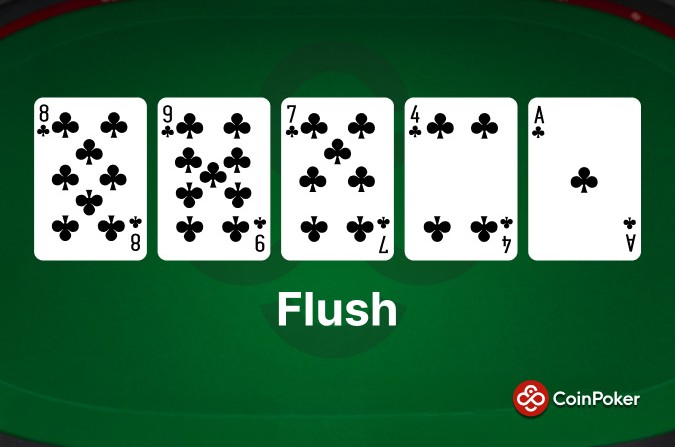
A “nut flush” is where you hold the highest possible flush given the cards on the board. For example, your hand is A♦ J♦, the board is 2♦ 6♦ 3♦ 8♣ K♠, giving you an Ace nut flush.
The strongest versions are the straight flush (five cards of the same suit and in order, like 8♦ 7♦ 6♦ 5♦ 4♦) and the unbeatable royal flush (A♠ K♠ Q♠ J♠ 10♠).
The Difference Between Flushes
Not all flushes are created equal. There are regular flushes, but also nut flushes, straight flushes, and royal flushes.
| Hand Name | Definition | Example |
|---|---|---|
| Flush | Five cards of the same suit, not in sequence. All suits match, ranks vary. | You hold 9♦ J♦ and the board is 2♦ 6♦ Q♦ 8♣ K♠. |
| Nut Flush | Five cards of the same suit, not in sequence. A player holds the highest available suited card, such as an Ace. | You hold A♦ K♦ and the board is 2♦ 6♦ Q♦ 8♣ K♠. |
| Straight Flush | Five cards in sequence, all of the same suit. | You hold 6♣ 7♣ and the board is 8♣ 9♣ 10♣ Q♦ 2♠. |
| Royal Flush | A♠ K♠ Q♠ J♠ 10♠ — the highest possible straight flush, all in the same suit. | You hold A♠ K♠ and the board is Q♠ J♠ 10♠ 3♦ 7♥. |

How Does a Flush Rank in Poker?
A flush ranks as the fifth-best hand in poker out of ten. It’s stronger than straights, three of a kind, two pair, one pair, and high card. That makes it one of the top combinations to have, since it usually means you have the best hand.
Be careful, however, because a flush still loses to monsters like the full house, four of a kind, straight flushes, and the royal flush. You can check out the full order in our poker hand rankings guide.
The real trick is remembering that not all flushes are equal. Ace-high flushes beat King-high flushes, and so on. A Jack-high flush will beat a 10-high flush, but lose to a Queen-high flush, and so on.
What is the best flush in poker?
A: As a flush is based on the highest card, so having an Ace in your hand gives you the best shot of winning.
What is the worst flush in poker?
A: Seven-high with the lowest kickers, like 7♦ 5♦ 4♦ 3♦ 2♦.
What Beats a Flush in Poker?
A flush loses to higher flushes, full houses, four of a kind, straight flushes, and the royal flush. Those last three are extremely rare (you’ll encounter one of these about 0.2% of the time). In most cases, you only need to worry about losing to higher flushes and full houses.
Remember, a Queen-high flush loses to an Ace-high or King-high flush every time. The real danger with a flush comes on paired boards like K♥ K♦ J♥ 9♥ J♠. Your A♥Q♥ might look strong, but it’s likely in a lot of trouble against a full house.
What Does a Flush Beat in Poker?
A flush beats plenty of hands: high card, one pair, two pair, three of a kind, and even a straight. That makes it one of the most valuable drawing hands in poker.
The real profit comes when you hit your flush against an opponent holding what they think is a strong hand, like a straight or three of a kind. In these spots, players have trouble folding and will often pay off multiple bets, giving you a chance to win a huge pot.
Flush vs Flush – Who Wins?
When two players make a flush, the highest card decides the winner. For example, Q♣ 10♣ 8♣ 6♣ 3♣ loses to A♣ 9♣ 8♣ 6♣ 3♣, since the ace is best. If both players share the ace, the next highest card breaks the tie, like a K♣ or Q♣. On a board like A♦ J♦ 8♦ 2♣ 4♦, K♦ 3♣ beats Q♦ 10♦ because king-high flush outranks queen-high.
What is the Probability of Getting a Flush?
In Texas Hold’em, you’ll make a flush about 6.5% of the time you hold two suited cards. A flush draw in poker means you are one card away from having five cards of the same suit. The table below shows the most common scenarios for getting a flush when holding two suited cards.
| Poker Situation | Your Hand (Example) | Board Stage | Board Hand | Chance % | Odds |
|---|---|---|---|---|---|
| Flopping a flush with suited hole cards | A♠ 9♠ | Flop | 2♠ 7♠ K♠ | 0.84% | 1 in 119 |
| Flopping a flush draw with suited hole cards | A♠ 9♠ | Flop | 3♠ 8♠ J♦ | 10.94% | 1 in 9 |
| Making a flush by the river with suited hole cards | A♠ 9♠ | River (full runout) | 2♠ 7♠ K♦ → 4♣ → 4♠ | 6.40% | 1 in 16 |
| Making a flush by the river with one suited card | A♠ K♦ | River (full runout) | 2♠ 7♠ Q♠ → 4♣ → 4♠ | 0.93% | 1 in 108 |
Flopping a flush draw sounds great. Remember, though, that still means you’ll miss it two-thirds of the time. Check out our guide on poker odds to master the math and improve your game.
What is the Probability of a Flush Improving?
A flopped flush is already a powerful made hand, but there are still rare situations where it can improve into something even stronger. Upgrades like full houses, quads, straight flushes, and royal flushes depend on specific board textures and limited outs, yet they do happen.
The examples below illustrate the realistic ways a flush can improve later streets and how frequently these upgrades occur.
| Improvement Situation | Your Hand (Example) | Board Stage | Board Hand | Number of Outs | Chance % | Chance Odds |
|---|---|---|---|---|---|---|
| Flopped Flush to Straight Flush (Open-Ended) on the Turn | 9♠ 8♠ | Turn | J♠ 10♠ 4♠ → Q ♠ or 7♣ | 2 | 4.26% | 1 in 23.5 |
| Flopped Flush to Straight Flush (Open-Ended) by the River | 9♠ 8♠ | Turn+ River | J♠ 10♠ 4♠ → 2♣ → 7♠ | 2 | 8.42% | 1 in 11.8 |
| Flopped Flush to Straight Flush (Gutshot) on the Turn | K♠ Q♠ | Turn | 10♠ 5♠ 9♠ → J♠ | 1 | 2.13% | 1 in 46.9 |
| Flopped Flush to Straight Flush (Gutshot) by the River | K♠ Q♠ | Turn+ River | 8♠ 5♠ 10♠ → 2♦ → J♠ | 1 | 4.26% | 1 in 23.5 |
| Flopped Royal Flush Draw to Royal Flush by the River | A♠ K♠ | Turn+ River | Q♠ 7♣ 10♠ → 2♣ → J♠ | 1 | 4.26% | 1 in 23.5 |
| Flopped Flush to Straight Flush | 9♠ 7♠ | Turn+ River | 2♠ 5♠ K♠ → 8♠ → 6♠ | 2 | 0.09% | 1 in 1081 |
Although these upgrades are uncommon, they highlight the few valuable paths a flush can take to become a dominating, virtually unbeatable hand. Runner-runner connections, or perfect straight-flush cards, can transform a strong holding into a monster.
3 Essential Flush Strategies
When comparing what beats what, flushes are powerful hands, but they can also be deceptively tricky to play. Some situations call for patience, others demand protection, and many require turning pressure into profit. The key is recognizing which spot you’re in and adjusting your plan accordingly.
Here are three refined strategies that help you extract maximum value from a made flush or flush draw.
A flush is not automatically a green light to pile money into the pot. Nut flushes can be slow-played on safe boards to let opponents put chips in with top pair, sets, or weaker draws. Mid-strength or low flushes often require more protection, so look carefully for spots to value bet.
You don’t want to give free cards, because paired boards or a fourth suited card could appear. Evaluate the board texture, blockers, and opponent tendencies before deciding whether to trap or protect.
The strength of your flush isn’t the only thing that matters; stack sizes change everything and determine your tournament strategy. Deep stacks give you room to disguise your hand, trap aggressive opponents, and go for maximum extraction. With shorter stacks, patience becomes a luxury you can’t afford.
You’ll often need to push value quickly or play your draws with more aggression because your fold equity and maneuverability are limited. Smart players weigh potential upside against risk, a core concept tied closely to understanding what beats what in poker.
Flush draws become far more profitable when they’re paired with straight draws, overcards, or even backdoor outs. These combo draws give you multiple ways to win, either by improving or by forcing folds. Instead of calling passively and hoping to hit, use your equity to apply controlled aggression.
Semi-bluffing in the right spots lets you dictate the action, puts opponents on difficult decisions, and builds pots for when you hit. Combo draws are some of the most valuable hands in poker because they blend real equity with fold equity.
Flush the Competition at CoinPoker
You’ve learned how to make a flush, what it beats, and how it can make or break stacks—now it’s time to put that knowledge into action. At CoinPoker, you’ll find games running 24/7 at every stake level, including micro-stakes and freerolls.
If you’re ready, sign up today and flush the competition where it counts: on the felt.
Play NowFlush Frequently Asked Questions
Five cards of the same suit, any ranks.
A-K-Q-J-10 all in the same suit, like A♠ K♠ Q♠ J♠ 10♠.
Five consecutive cards of the same suit, like 8♦ 7♦ 6♦ 5♦ 4♦.
You are one card away from having five cards of the same suit.
The highest possible flush on the board.
With two suited cards, you’ll flop a flush about 1 in 119 hands. If you flop a flush draw, you’ll complete it by the river about 1 in 3 times.
A flush beats high card, one pair, two pair, three of a kind, and straight.
Full house, four of a kind, straight flush, royal flush.

Explore More


Guides
The go-to resource for mastering poker with expert tips and strategies. Our guides will elevate your poker skill level.
66 Posts
News
Find the latest poker news and latest CoinPoker Newsletters. Get updates about games, promotions, and crypto news.
90 Posts